
A coffee mug, a Florida festival, and the story behind both.
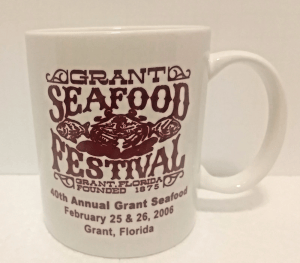
Every once in a while, while looking through the things people leave behind at an estate sale, I come across something that catches my attention for reasons other than its appearance or potential resale value. Sometimes it’s an old photograph, a book, or a piece of advertising that has somehow survived the years. In this particular case, it was a coffee mug commemorating the 40th Annual Grant Seafood Festival, held February 25 and 26, 2006, in Grant, Florida.
There wasn’t anything especially remarkable about the mug itself. It was the kind of souvenir you might purchase at a local festival, take home, and eventually put away in a cupboard with all the other coffee mugs you’ve accumulated over the years. What interested me was the fact that this little community had apparently been holding a seafood festival for forty years, and I found myself wondering how something like that got started and whether it was still going on.
As it turns out, the Grant Seafood Festival has a history that goes considerably beyond a weekend of seafood and entertainment.
A Florida Community and a Fish Fry
Grant is a small community in southern Brevard County, Florida, along the Indian River Lagoon, in an area that eventually became part of the incorporated town of Grant-Valkaria. Its history reaches back to the nineteenth century, long before the Space Coast became associated with rockets and the Kennedy Space Center.
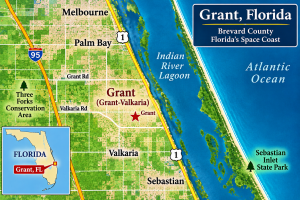
The seafood festival began in 1966 as a community fish fry, organized by local residents who wanted to bring people together. Among those involved in its beginnings were Ann Christenson and Roland Hill, who are recognized by the Grant Community Club as co-founders of the festival. Christenson later recalled that those early fish fries served approximately 200 people, which gives us some idea of how modest the whole undertaking was in the beginning.
It’s interesting to think about how many community traditions begin that way, with a few people getting together to organize something that seems worthwhile at the time, never imagining that it might still be taking place decades later. In Grant’s case, what began as a relatively small gathering gradually attracted more visitors, required more volunteers, and developed into an annual event that would become familiar to people throughout the region.
What makes the festival particularly interesting, however, isn’t simply that it grew larger over the years. It’s the way the community chose to operate it.
The People Behind the Festival
Unlike many large festivals that depend upon commercial food vendors and outside operators, the Grant Seafood Festival has maintained a tradition of preparing and serving its own food through the efforts of local volunteers.
According to the festival’s organizers, approximately 500 to 600 volunteers help make the event possible, with families often participating across several generations. Some of the people working at the festival today grew up watching their parents or grandparents do the same work, and that kind of continuity says something about how deeply the event has become part of the community.
Of course, putting on a festival of this size requires considerably more than showing up on Saturday morning with a few frying pans. There are supplies to purchase, cooking areas to prepare, equipment to maintain, and all the organizational work that goes into accommodating thousands of visitors over a single weekend. Much of that work takes place long before the first plate of seafood is served.
The food itself remains central to the celebration, with shrimp, fish, oysters, clam chowder, hush puppies, and other seafood favorites drawing visitors back year after year. But behind every serving is a volunteer organization that has managed to preserve something of the original community fish fry, even as the festival has grown far beyond what its founders might have anticipated.
There’s something appealing about that arrangement. The festival may attract people from well beyond Grant, but the people who put it together remain closely connected to the place where it began.
More Than a Weekend Celebration
One of the things I found most interesting while researching the festival was discovering what happens to the money it raises.
The Grant Community Club uses festival proceeds to support educational scholarships and several local institutions, including the Grant Community Library, the Grant Historical House, and the Grant Community Center. These are the kinds of places that help give a community its identity, although they don’t always receive much attention from people passing through.
The scholarship program is especially impressive. According to the festival’s published history, more than $2 million has been raised for college scholarships over the years, an accomplishment that takes on greater meaning when you remember that the entire undertaking began with a fish fry serving a couple hundred people.
The community library is another example of what those efforts help support. Rather than operating as a conventional county library branch, it has relied upon the work of volunteers and the support of the Grant Community Club.
When you consider those contributions together, the festival begins to look a little different. Certainly, it’s an opportunity for visitors to enjoy good food, entertainment, and a weekend outdoors, but for the people of Grant, it also provides a means of supporting institutions and opportunities that benefit their community throughout the year.
Forty Years Later: The 2006 Festival
That brings us back to the coffee mug and the weekend of February 25 and 26, 2006, when Grant celebrated the fortieth annual edition of its seafood festival.
By that time, the festival had become a well-established tradition, having grown from its modest beginnings in 1966 into an event supported by hundreds of volunteers. Forty years is quite an accomplishment for any community organization, particularly one that depends so heavily upon people giving their time and effort without expecting anything in return.
I’d like to know more about that particular weekend. What was the weather like? How many people attended? What entertainment was scheduled, and what did the festival grounds look like twenty years ago? Those are questions that contemporary photographs, newspaper reports, and the memories of people who were there might help answer.
For now, I haven’t found enough reliable information to describe the 2006 celebration in that kind of detail, and I’d rather leave those questions open than fill the gaps with assumptions.
What we do have is a small piece of memorabilia produced to commemorate the occasion, which suggests that someone wanted visitors to have something tangible to remember the fortieth festival.
Twenty years later, one of those souvenirs turned up at an estate sale in Oklahoma.
How Did It Get Here?
I have no idea how a coffee mug from a Florida seafood festival made its way to Oklahoma, although that’s part of what makes looking through old household belongings so interesting.
Perhaps someone attended the festival while vacationing in Florida, or maybe the mug belonged to a family that once lived in the area and later moved west. It could just as easily have been given as a gift, passed along to someone else, or purchased secondhand long before it arrived at the estate sale where I found it.
Without knowing anything about its previous owner, there’s really no way to establish its travels, and I don’t think the story needs an invented explanation.
What interests me is that an ordinary souvenir, probably made in considerable numbers and never intended to become particularly valuable, has survived long enough to introduce someone in Oklahoma to a community tradition in Florida.
I started out knowing nothing about the Grant Seafood Festival beyond the name and dates printed on a coffee mug. After spending some time researching it, I came away with a much greater appreciation for the people who started the festival and the generations who have continued the work.
We tend to think of history in terms of major events, important people, and places that appear in textbooks, but there’s another kind of history preserved in the ordinary things people keep around their homes. A souvenir from a local celebration may not seem especially important until someone takes the time to find out what it represents.
In this case, it represents a community that has spent decades coming together, feeding its neighbors and visitors, supporting education, and maintaining a tradition that began with a simple fish fry.
And all of that came to my attention because of a coffee mug sitting on a table at an Oklahoma estate sale.
Sources and acknowledgments
Historical background was researched using the official Grant Seafood Festival website and materials published by the Grant Community Club.


Leave a Reply