
A Little Book with a Story to Tell
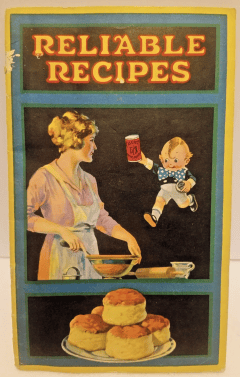
It arrived as part of a lot of old paper collectibles, the kind of assortment collectors refer to as ephemera. Among the assorted pieces was a colorful little booklet titled Reliable Recipes, published by the Calumet Baking Powder Company of Chicago. With only 32 pages, it was hardly an impressive publication by size, but its cheerful illustrations and familiar household recipes suggested there might be more to its story than first appeared.
On the cover, a woman is busy preparing something in the kitchen while a little boy hurries toward her carrying a can of Calumet Baking Powder. Inside are recipes for biscuits, cakes, breads, and other baked goods that would have been familiar in American households a century ago. What makes the booklet interesting, however, isn’t simply the collection of recipes, but the reason a baking powder manufacturer would go to the trouble and expense of producing them.
To understand that, we need to look at the company behind the familiar can and the role these little cookbooks played in its advertising.
A Familiar Name in the Kitchen
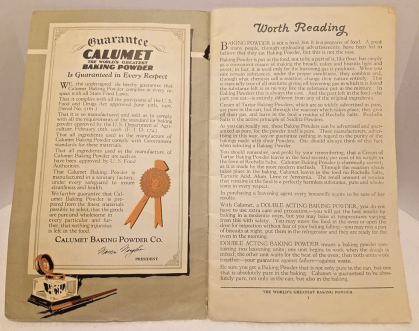
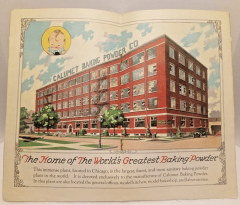
Calumet Baking Powder began in Chicago in the late 1880s, when William Monroe Wright established a business that would eventually become one of the country’s best-known baking powder manufacturers. The company entered a competitive market in which convincing customers to purchase a particular brand was important, but persuading them to return for another can was just as valuable.
One way Calumet encouraged that loyalty was by providing recipes that demonstrated how its baking powder could be used in everyday cooking. A successful batch of biscuits or a cake that turned out particularly well gave customers a practical reason to trust the product, especially when the instructions came directly from the manufacturer.
By publishing collections of recipes under its own name, Calumet could provide something useful while keeping its baking powder closely associated with the foods people prepared for their families.
A Cookbook With Another Purpose
Calumet published numerous editions of Reliable Recipes over the years, along with smaller pamphlets devoted to particular kinds of baking. Some were substantial cookbooks containing dozens of additional recipes, while others were more modest publications that could be kept conveniently among the household’s cooking instructions.
Although our copy of Reliable Recipes carries no apparent publication date, we were able to identify it by comparing its illustrations, advertising language, and 32-page format with a matching copy held in Michigan State University Libraries’ Alan and Shirley Brocker Sliker Culinary Ephemera Collection. The university dates its copy to approximately 1920, giving us a reasonable indication of when ours was published.
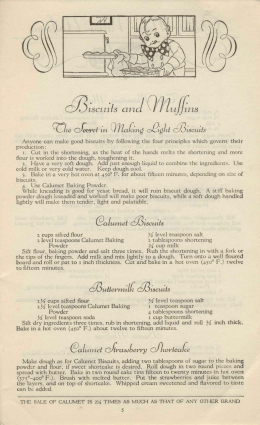
Throughout its pages, the company combined practical instructions with reminders of the product that made the recipes possible. Calumet emphasized the reliability of its baking powder and promoted what it called its double-action formula, presenting the booklet as both a helpful kitchen companion and evidence of the company’s commitment to successful baking.
The advertising was hardly disguised, but that was not necessarily a disadvantage. Readers received recipes they could use, and Calumet received an opportunity to keep its name in front of them whenever they returned to the booklet.
From the Company to the Kitchen
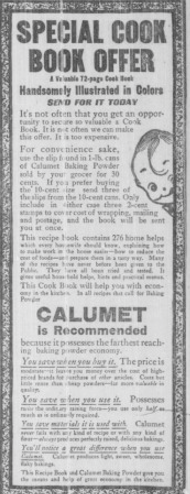
Calumet’s newspaper advertisements provide a glimpse of the effort the company made to distribute its recipe publications. In 1919, an advertisement in The Alvin Sun, July 11, offered a 72-page cookbook to customers who purchased Calumet Baking Powder, saved the required slips from its containers, and mailed them to the company along with postage stamps.
By 1922, other advertisements offered editions of Reliable Recipes to anyone who wrote to the company’s Home Economics Department in Chicago, without requiring a purchase. Calumet also invited readers to submit questions about cooking and kitchen equipment, extending its relationship with customers beyond the simple sale of baking powder.
Although those advertisements concern larger editions and do not establish precisely how the 32-page booklet was distributed, they illustrate how deliberately Calumet worked to place its recipes in American homes. The company understood that a useful cookbook might remain within reach long after the newspaper advertisement that introduced it had been discarded.
Something Worth Keeping
A booklet filled with familiar recipes had a practical value that extended beyond its original purpose as advertising. If a family found a biscuit recipe that produced good results, or a cake that became a favorite, there was every reason to keep the instructions among the other household recipes.
Over time, a booklet like this might have found its way into a kitchen drawer, onto a shelf beside larger cookbooks, or into a box containing handwritten recipes passed between family members. We have no way of knowing where this particular copy spent its early years, but its survival suggests that someone considered it worth keeping rather than discarding it with the other advertising materials that came into the household.
For Calumet, that possibility was especially valuable because the company name remained attached to every recipe. Each time the booklet was opened, the reader encountered another reminder of the baking powder manufacturer whose product was being promoted.
The Message on the Back
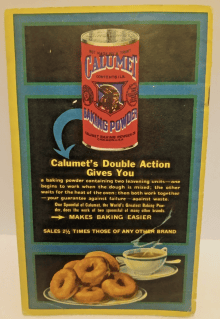
The back cover makes the booklet’s advertising purpose particularly clear, with illustrations of baked goods surrounding the familiar Calumet can and a description of the company’s double-action baking powder.
Calumet explained that its product contained two leavening units, one beginning to work when the dough was mixed and the other responding to the heat of the oven. The company presented this as an advantage that could help bakers obtain dependable results while avoiding wasted ingredients and disappointing cakes or biscuits.
The back cover also carried the claim that Calumet’s sales were two and a half times those of any competing brand. Although that figure should be understood as a claim made in the company’s advertising rather than an independently established statistic, it illustrates the confidence with which Calumet promoted its place in American kitchens.
A Little Book That Outlasted Its Purpose
More than a century after booklets like this were being distributed, this copy of Reliable Recipes remains a small but revealing piece of American advertising history. The company printed it to encourage people to use Calumet Baking Powder, yet the recipes and illustrations gave it a usefulness that extended beyond the original sale.
We don’t know who first owned this particular booklet, whether they received it through a promotional offer, or which of its recipes they may have prepared. What we do know is that someone preserved it, allowing a publication originally intended to sell an everyday household product to survive long after the circumstances of its creation had passed.
The baking powder purchased by its earliest readers was used up generations ago, but the little book that helped promote it has remained, carrying with it a glimpse of the kitchens, advertising practices, and everyday routines of another time.
And sometimes that’s reason enough to take a second look.


Leave a Reply