
The Story Behind a KPM Steamship Booklet
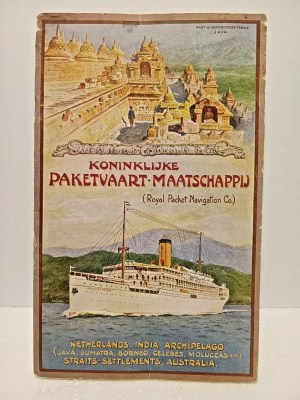
Sometimes an interesting piece of history turns up when you’re not looking for one. We came across this illustrated booklet among a collection of older paper items, and at first glance, it appeared to be little more than an old steamship brochure. But as we began examining its pages and looking into the company behind it, we discovered that this small publication had quite a story to tell.
Published by the Koninklijke Paketvaart Maatschappij, better known as the Royal Packet Navigation Company or simply KPM, the booklet dates to around 1915. Inside are photographs, descriptions of destinations, and a map showing the company’s shipping routes throughout the Dutch East Indies, now Indonesia. What makes it interesting isn’t simply its age, but the picture it gives us of a time when steamships connected communities, carried commerce, and provided an essential means of transportation across a vast region of islands.
Connecting the Islands
The Royal Packet Navigation Company was established in Amsterdam in 1888 and began operating in January 1891 with a fleet of 29 steamers. At the time, the Dutch East Indies consisted of thousands of islands spread across an enormous area, and transportation by water was essential to the movement of people, merchandise, and mail. KPM developed an extensive network of scheduled shipping services connecting major commercial centers with smaller ports and communities, eventually becoming an important part of the region’s transportation system.
By the time our booklet appeared, the company had been operating for more than two decades, carrying everything from agricultural products and commercial merchandise to government supplies and passengers. Its operations were closely connected with the Dutch colonial administration, which relied on regular shipping services to maintain communications and transportation throughout the islands. While the booklet naturally emphasizes the advantages of traveling with KPM, the company’s role extended well beyond passenger excursions and sightseeing.
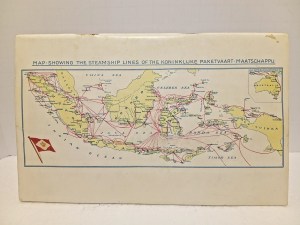
One of the most interesting features of the booklet is its route map, which illustrates just how extensive those services had become. Red lines stretch across the region, connecting ports on Java, Sumatra, Borneo, Celebes, and numerous smaller islands, with Singapore serving as an important international connection. Looking at the map today, it’s worth remembering that every one of those lines represented actual voyages, with ships arriving and departing, passengers moving between destinations, and cargo being transferred from one port to another. What appears to be a relatively simple map was actually a complicated transportation network operating across thousands of miles of water.
Looking Through the Booklet
The booklet itself contains approximately 40 pages and measures about eight by five inches, making it a convenient size for someone planning a journey or looking into the company’s services. Its illustrated cover features a colorful view of Borobudur Temple in Java, with a white passenger steamship pictured below. The vessel is identified as the Melchior Treub, one of the ships discussed in the publication, and the combination of an impressive historical landmark with a modern steamship tells us something about how the company wanted prospective travelers to imagine their journey.
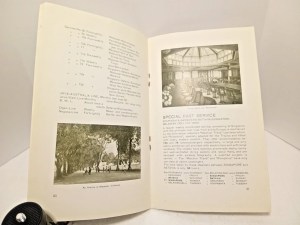
Inside, the photographs and descriptions introduce readers to destinations throughout the Dutch East Indies while also providing information about the company’s passenger services. Among the illustrations are a tree-lined avenue at Macassar, on Celebes, and the dining saloon aboard the steamship Rumphius. Other pages describe routes, accommodations, and connections with international steamship services, giving prospective passengers a better understanding of how they might arrange their travels.
What I find particularly interesting about these old publications is how much they reveal about the period in which they were produced. The company was presenting a region of the world that many European travelers might never have visited, using photographs and descriptions to make those destinations more familiar and appealing. At the same time, it’s important to recognize that this was promotional literature produced by a shipping company operating within a colonial system. The photographs and descriptions reflect the company’s interests and the expectations of its intended customers, rather than offering a complete account of the people and cultures of the islands themselves.
Traveling by Steamship in 1915
The pages describing KPM’s special fast services provide some of the booklet’s most interesting details, particularly when it comes to what passengers could expect aboard ship. The company advertised regular connections between Surabaya, Samarang, Batavia, Singapore, and Belawan Deli, including services coordinated with international mail steamers. These connections were important because a traveler arriving from Europe or another part of the world might need to transfer between vessels to reach a particular destination.
Two steamships receive special attention in the booklet: the Melchior Treub and the Rumphius. According to the company’s description, both vessels had been adapted for passenger service, with accommodations for 124 and 76 saloon passengers respectively. The advertised conveniences included electric fans, spacious promenade decks, large windows, comfortable dining facilities, and social halls, while wireless telegraphy provided a means of communication that was becoming increasingly important in maritime travel.
The booklet also promotes a journey between Singapore and Batavia taking just 38 hours aboard these steamers, a detail that gives us some idea of the company’s emphasis on efficient transportation. For passengers accustomed to much longer voyages, a reliable scheduled service with reasonably comfortable accommodations would have been an attractive proposition, particularly when connections with other shipping lines were involved.
Of course, the experience of traveling aboard one of these vessels depended a great deal on the accommodations a passenger could afford. The booklet concentrates on saloon passengers and the conveniences provided for them, which tells us something about the audience the company hoped to attract. The photographs of the dining saloon and passenger facilities help illustrate that part of the story, although they cannot tell us what the journey was like for everyone aboard.
An Unexpected San Francisco Connection
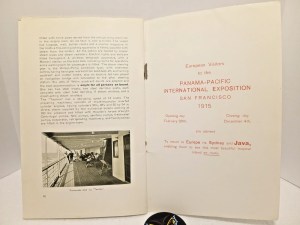
One of the more surprising details in the booklet appears in an advertisement directed toward European visitors attending the Panama-Pacific International Exposition in San Francisco in 1915. At first, it might seem unusual to find a reference to an American exposition in a publication promoting steamship travel through the Dutch East Indies, but the connection makes sense when we consider how international passenger travel worked at the time.
The Panama-Pacific International Exposition was held from February 20 through December 4, 1915, celebrating the completion of the Panama Canal while showcasing achievements in industry, technology, architecture, and the arts. It attracted visitors and exhibitors from around the world, including Europeans who had traveled considerable distances to attend. For shipping companies, those visitors represented an opportunity to promote routes and destinations that might otherwise receive little attention.
KPM’s advertisement encouraged European visitors to consider returning home by way of Sydney and Java, turning what might have been a straightforward return journey into an extended trip through the islands served by the company. It was an imaginative piece of marketing, connecting an international event in California with steamship services operating thousands of miles away in Southeast Asia.
The advertisement also provides an important clue to the booklet’s age. Although the pages we’ve examined do not establish an exact printing date, the reference to the 1915 exposition supports placing the publication around that year. More importantly, it gives us a direct connection between the booklet and a particular moment in international travel history, when shipping companies were actively encouraging passengers to explore alternative routes around the world.
A Company with a Wider Reach
The booklet’s title page provides another indication of KPM’s importance, describing the company as operating royal mail services under contract with the Netherlands Indies government. It lists head offices in Amsterdam and Batavia, along with a representative in Sydney, Australia, and even includes the company’s telegraphic address. These details may seem ordinary today, but they help illustrate how an international shipping business maintained its operations and communications in the years before modern electronic networks.
KPM’s ships were part of a larger system connecting commercial interests, government offices, and communities throughout the Dutch East Indies. The company operated during a period of considerable political and economic change, and the world represented in this booklet would eventually be transformed by the events of the twentieth century, including the Second World War and Indonesian independence.
That later history gives the booklet another dimension. What was originally intended as a practical guide to steamship services has become a record of a transportation system and a political setting that no longer exist in the same form.
A Small Survivor from Another Time
Our copy has certainly seen better days, although that’s hardly surprising for a booklet that has been around for more than a century. The illustrated cover shows wear around its edges, the pages have aged, and the staples holding everything together have developed rust. Even so, the photographs, advertisements, route map, and descriptions remain available to examine, allowing us to appreciate something of the publication’s original purpose.
I sometimes wonder about the people who owned these old pieces of paper before they eventually found their way into collections and estate sales. In this case, we have no way of knowing who originally picked up the booklet, whether that person ever traveled aboard a KPM steamship, or how it survived the intervening years. It may have been kept as a souvenir of an actual journey, or simply saved by someone who was interested in traveling to distant places. Without further evidence, those questions will probably remain unanswered.
What we do know is that this small booklet has preserved a surprisingly detailed picture of international travel in the early twentieth century. Its pages take us from the shipping routes of the Dutch East Indies to passenger accommodations aboard steamships, and even to an international exposition held in San Francisco in 1915. All of those connections are contained within a publication that could easily have been overlooked as nothing more than an old travel brochure.
That’s one of the reasons I enjoy researching objects like this. They don’t have to be rare works of art or famous historical artifacts to have an interesting story behind them. Sometimes all it takes is an old booklet, a few surviving photographs, and the curiosity to find out what they can tell us.
And in this case, they had quite a bit to say.
Sources and Further Reading
Royal Packet Navigation Company, original illustrated booklet, circa 1915, Longview Finds collection.
National Library Board, Singapore, historical information concerning the Koninklijke Paketvaart Maatschappij.
Leiden University Libraries, Tourism in the Dutch East Indies, 1870–1945.
Historical records of the Panama-Pacific International Exposition, San Francisco, 1915.


Leave a Reply