
A Forgotten Comedy with a Curious History
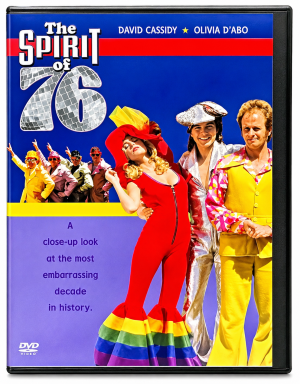
There it sits, tucked among dozens of other DVDs. A movie with an unfamiliar title, a cover full of outrageous seventies clothing, and David Cassidy’s name across the top.
The Spirit of ’76.
Never heard of it.
You pick it up, turn it over, and discover that Cassidy stars alongside Olivia d’Abo and Geoff Hoyle. Then there are the unexpected names: Leif Garrett, Tommy Chong, and members of Devo. And somewhere among the credits, you notice the names Reiner and Coppola, two families with quite a history in Hollywood.
What exactly is this movie?
As it turns out, it’s a 1990 comedy about time travelers from the year 2176 who set out to visit 1776, only to accidentally land in 1976 instead. Director Lucas Reiner later suggested that the movie had been released several years too early, before the wave of seventies nostalgia that would sweep through the 1990s.
Think about that for a moment. A movie about time travelers arriving in the wrong year may have suffered exactly the same problem when it reached theaters.
And that’s only the beginning of the story.
The premise is wonderfully ridiculous. By the year 2176, much of America’s recorded history has been lost following a magnetic storm, and the people of the future are trying to piece together what happened in the nation’s past. Their solution is to send three travelers back to 1776, where they hope to learn something about the founding of the country. Unfortunately, their time machine misses the intended destination by two hundred years, depositing them in the middle of America’s Bicentennial celebration instead.
What follows is a tour through the peculiar landscape of the 1970s, complete with bell-bottoms, platform shoes, disco music, and an abundance of polyester. Cassidy, d’Abo, and Hoyle play the bewildered travelers, trying to understand a world that bears little resemblance to the one they expected. The people they encounter are just as confused by their visitors, although in a decade that produced pet rocks, mood rings, and leisure suits, perhaps three strangers from the future weren’t quite as unusual as they might have been elsewhere.
The people behind the camera are almost as interesting as those appearing in front of it. Lucas Reiner directed the film and developed the story with Roman Coppola, bringing together two families whose contributions to American filmmaking stretch across generations. Lucas is the son of Carl Reiner and the brother of Rob Reiner, while Roman is the son of Francis Ford Coppola, who helped finance the production. Sofia Coppola handled the costumes, and both Carl and Rob Reiner appeared in the film. For a relatively obscure comedy, that’s quite a collection of talent.
The supporting cast adds another layer to the story. David Cassidy and Leif Garrett had been among the most recognizable teen idols of the seventies, and their presence gave the film a direct connection to the decade it was revisiting. Tommy Chong, Moon Zappa, Barbara Bain, and members of Devo and Redd Kross contributed their own associations with the music, television, and popular culture of the period. Rather than simply hiring actors to imitate the seventies, the filmmakers brought together people who had actually been part of its entertainment landscape. It’s an unusual approach, and one that helps explain why the movie feels as much like a reunion as a comedy.
With that kind of talent involved, you might expect The Spirit of ’76 to have attracted considerable attention when it reached theaters in October 1990. Instead, its theatrical run was brief, and the reviews were mixed. The movie was inviting audiences to laugh affectionately at a decade that had ended only ten years earlier, when some of its fashions and cultural habits were probably still fresh enough to be embarrassing.
Lucas Reiner apparently recognized that problem himself. In a later DVD commentary, as recounted by a reviewer for DVD Talk, he suggested that the movie had been released before audiences were ready for the seventies nostalgia that would become increasingly popular during the 1990s. Looking back, it’s an intriguing possibility. The filmmakers had assembled a cast with genuine connections to the decade, surrounded them with the clothes, music, and popular culture of the period, and then released the whole thing at a time when audiences might not have been particularly interested in remembering any of it.
But the movie’s story didn’t end with its disappointing theatrical release. In January 1992, the Nuart Theatre in Los Angeles began showing The Spirit of ’76 at midnight on Friday nights, and something rather unexpected happened. People started turning up in seventies clothing, repeating dialogue along with the actors, and even getting out of their seats to dance the Hustle. By March, the Los Angeles Times was reporting audiences of roughly two hundred people at these screenings.
Imagine walking into a theater to see a movie that had practically disappeared after its original release, only to find yourself surrounded by people dressed for a Bicentennial party. Instead of sitting quietly through the picture, they were making an evening of it, laughing at the familiar references and joining in whenever the opportunity presented itself. What had failed to capture much attention in conventional theaters was finding a different sort of audience at midnight, one that seemed to understand the spirit in which the movie had been made.
Whether those screenings represented the beginning of a lasting cult following is another question, but they certainly demonstrated that the film could connect with people under the right circumstances. It hadn’t suddenly become a different movie. It was still the same strange comedy about travelers from the future stumbling into America’s Bicentennial, but now there were audiences willing to embrace its peculiar sense of humor.
And that brings us back to the DVD that started this little investigation.
Warner Home Video released The Spirit of ’76 on DVD on June 3, 2003, more than a decade after those midnight screenings. What makes the edition particularly interesting isn’t simply that it contains an obscure film, but that it also preserves some of the story behind its creation. Among the supplemental features is a commentary with Lucas Reiner and his father, Carl Reiner, along with behind-the-scenes material, additional scenes, outtakes, and a music video featuring Redd Kross performing “1976.”
For anyone curious about the people who made the film, those extras offer something that a straightforward viewing of the movie cannot. They provide an opportunity to hear about the production from the people involved and to see material that didn’t make it into the finished picture. That’s one of the pleasures of older DVD releases, especially when the films themselves have slipped out of the public conversation. Sometimes the additional material becomes an important part of preserving their history.
The original Warner edition dates back more than twenty years, and copies still turn up for sale through secondhand marketplaces. Some sellers ask surprisingly high prices for sealed examples, although an asking price isn’t necessarily an indication of what a buyer will actually pay. We also haven’t established whether Warner officially discontinued the edition, so it would be premature to declare it out of print. What we can say is that the 2003 DVD remains an interesting physical record of a movie whose unusual history extends well beyond its original theatrical release.
And perhaps that’s what makes this particular discovery so enjoyable. What first appeared to be an unfamiliar comedy with a peculiar cast turned out to involve two of Hollywood’s best-known filmmaking families, a collection of performers closely associated with the seventies, and a second life in a Los Angeles theater where audiences came dressed for the occasion.
There’s something rather fitting about a movie whose characters arrived in the wrong year finding an audience only after its own moment had passed. Whether The Spirit of ’76 was genuinely ahead of its time or simply a comedy that appealed to a particular crowd, its history is considerably more interesting than its modest reputation might suggest.
And sometimes that’s reason enough to take a second look.
Sources and Further Reading
American Film Institute Catalog, The Spirit of ’76, cast, credits, and production information.
Los Angeles Times, March 1, 1992, Nuart Theatre midnight screenings.
DVD Talk, The Spirit of ’76 DVD review, supplemental features and commentary.


Leave a Reply