
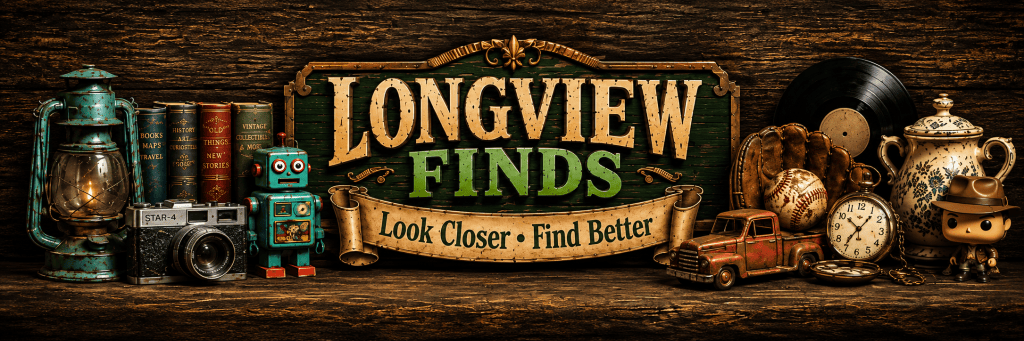
Ordinary objects get a second chance to tell their stories.
Welcome to Longview Finds. We explore physical media, vintage collectibles, rare ephemera, and forgotten technology, uncovering the hidden histories behind items passed over at yard sales, thrift stores, and estate auctions.
Learning to See History in the Dirt
Sometimes history isn’t in a textbook, a museum, or a documentary. Sometimes you’re holding it in your hand. I learned that years ago while living in the Mojave Desert. I had always liked history, but out there somebody introduced me to bottle digging, and suddenly local history wasn’t something I had to read about. It was buried in the ground around me. We searched old mining town dumps, abandoned foundations, and long-dried outhouses for bottles, tokens, coins, and whatever else earlier generations had left behind. I learned that a glass bottle could begin telling you its age before you ever looked up the company embossed on the side. The seam line mattered, so did the way the lip was attached, the shape of the base, and even the impurities in the glass. Once I learned what to look for, an old bottle wasn’t just trash anymore. One of the first lessons my mentor taught me was to look for round. I was digging too slowly because I was afraid I would break something, and he told me that nature doesn’t make perfect circles. Look for the arc of a bottle shoulder or something else that doesn’t belong in the dirt around it. I’ve never forgotten that. It’s the same logic as that classic exercise: “One of these things is not like the others.” Once you learn to notice what doesn’t belong, you start seeing things everyone else walked right past.
From Desert Dumps to Thrift Store Shelves
What fascinated me just as much was wondering how those objects ended up there. Three of us could work our way across an old dumping ground six feet apart, and one person might find bottle after bottle while another found nothing but broken glass. Move ten feet up the hill and suddenly there were more finds. Every discovery raised questions: Who used this? Why was it left here? How did it survive? Occasionally the answer seemed obvious, like the twenty-dollar gold piece somebody lost down an outhouse, but usually we could only wonder. That curiosity was the real heart of the treasure hunt, and it still is. I don’t do much bottle digging in the Mojave anymore, but I’ve never stopped looking. These days the ground might be a yard-sale table, a thrift-store shelf, or a box of miscellaneous paper ephemera at an estate sale. I can walk past twenty ordinary items and suddenly something makes me stop. I don’t always know what it is at first. There’s just something peculiar that makes me ask: Wait a minute, what is this?
The Mission of Longview Finds
That instinct is the foundation of Longview Finds. Yes, this is a resale business, and items eventually have to sell, but financial profit isn’t the only thing that makes finding them enjoyable. There is a deep satisfaction in spotting something that has been repeatedly passed over, picking it up, and discovering that there is far more to it than anybody realized. Sometimes it’s financially valuable; sometimes it isn’t. Either way, the story behind it is worth finding. Things keep passing through our hands that send us down fascinating research rabbit holes:
- Pre-Owned DVDs: Inexpensive discs with surprising release histories.
- Vintage Media & Toys: Childhood collectibles that showcase 1990s collecting trends.
- Trading Cards: Pokémon cards that showcase the rise of a Japanese franchise into a global phenomenon.
- Historical Ephemera: A 100-year-old steamship brochure that provides insight into travel before airplanes.
The objects themselves aren’t necessarily the stories. They are where the stories begin.
Modern Research Meets Old-Fashioned Instinct
The way we research information today would have seemed like pure science fiction when I was digging in the desert. Years ago, identifying an obscure item meant finding an antique dealer, a specialist collector, or a physical reference book. Today, research is dynamic.
I bring the physical objects, personal experience, and the sourcing instincts built over decades. To speed up the historical deep-dives, I work alongside an AI partner, whom I call Alice, to help cross-reference database records, historical archives, and catalog codes in seconds.
We work closely together. I bring the physical evidence and the questions; Alice helps chase those questions through vast amounts of digital information. But sources still matter. We verify underlying records, compare catalog variations, and remain honest when an item’s origin is uncertain.
You’ll also occasionally hear from CeCe, our dragon mascot. CeCe tracks the growth of Longview Finds and holds rather strong opinions about human beings throwing away perfectly fascinating history. She is slightly less diplomatic than I am.
Welcome to the Archive
What we are building here is an ongoing archive of discoveries worth investigating. We’ll explore physical media, forgotten technology, pop culture collectibles, vintage advertising, and paper ephemera as they land on our shelves.
We’re doing this because these ordinary items carry extraordinary history sitting quietly inside them. All it takes to find a story is noticing that something doesn’t quite belong, and asking the simplest question of all:
What’s this?
Thank you for visiting Longview Finds, where ordinary objects get a second chance to tell their stories.


Leave a Reply